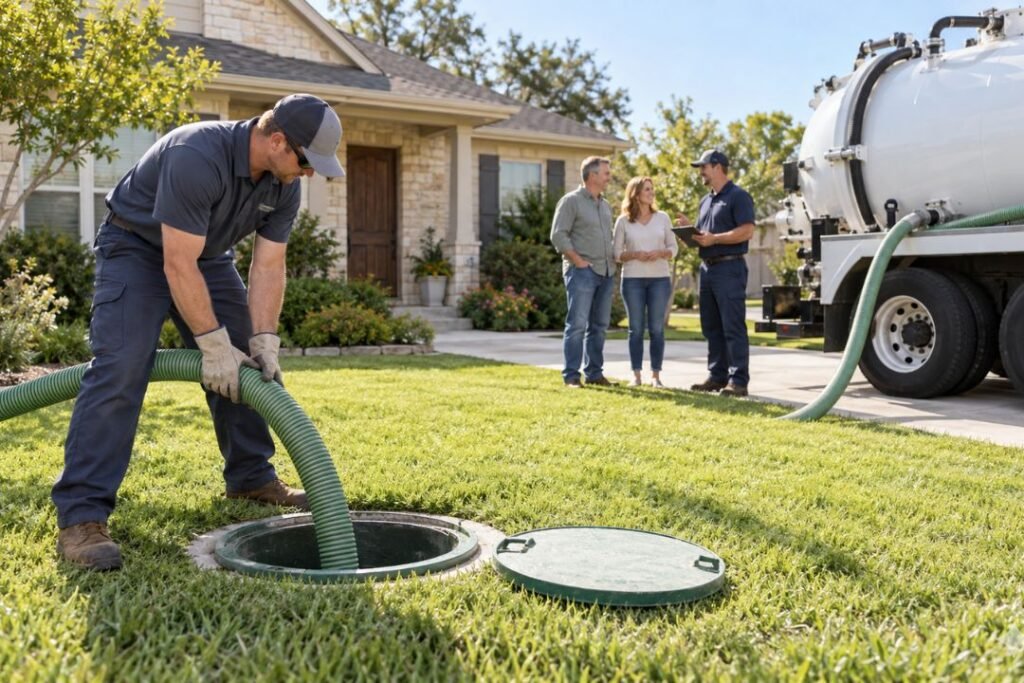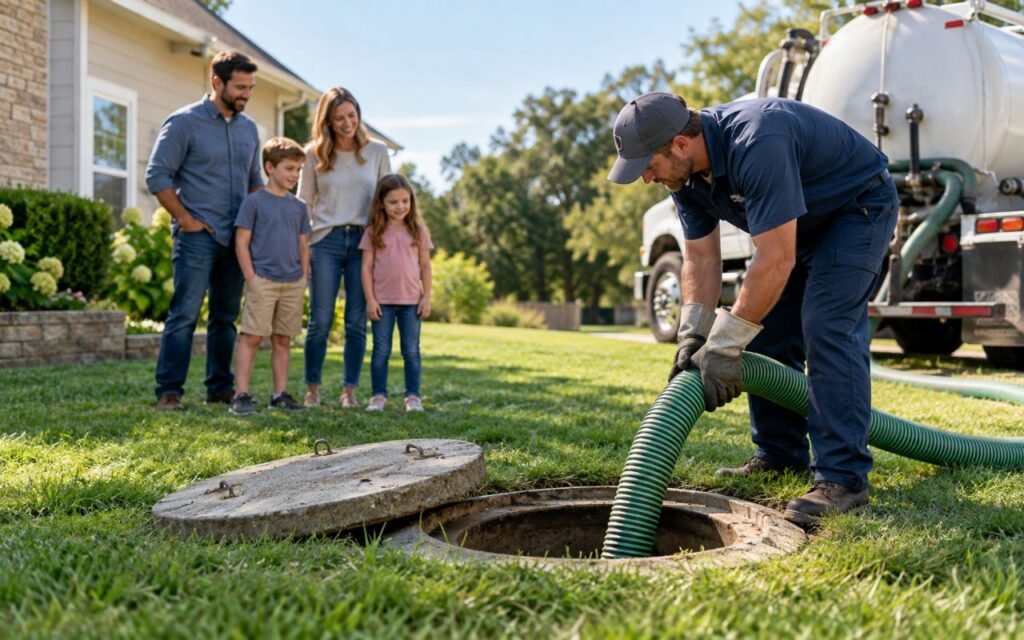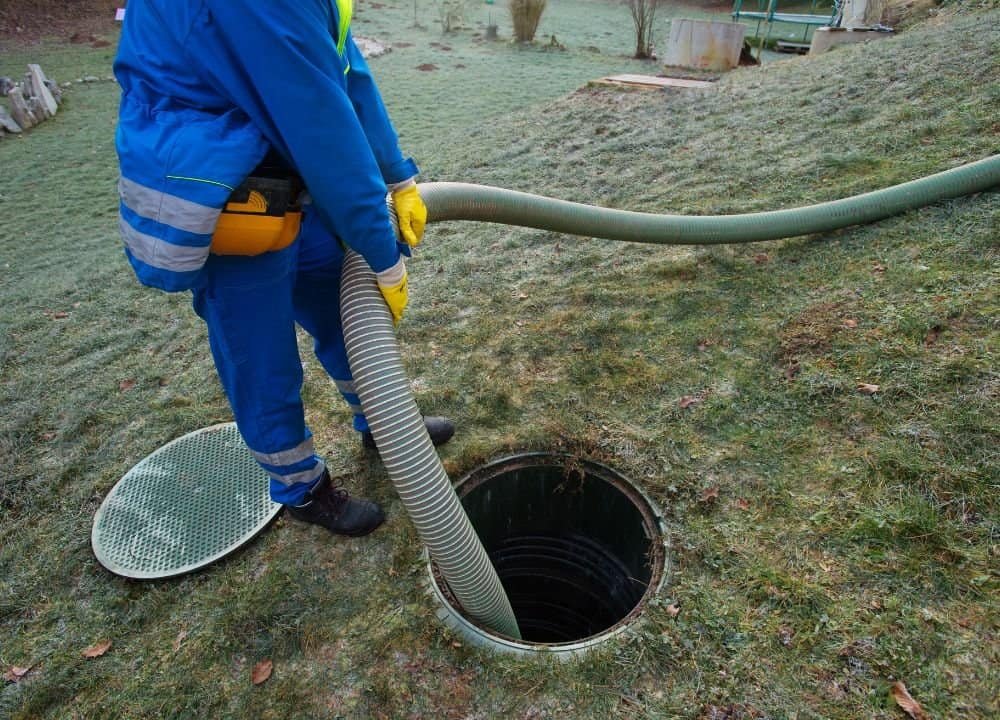
Most household septic tanks are typically pumped every 3 to 5 years, according to the U.S. Environmental Protection Agency. However, this is a general guideline rather than a fixed schedule for every home.
Some tanks need pumping sooner. Others may be able to go longer between pump-outs when inspections show that sludge and scum have not accumulated enough to require service.
Your actual septic tank pumping frequency depends on several factors, particularly household size, tank capacity, wastewater use, and the amount of solids entering and accumulating in the tank.
For Texas homeowners, TCEQ provides additional planning guidance based on tank capacity and the number of people living in the home. That guidance shows why a family of 5 using a 750-gallon tank can have very different maintenance needs from 2 people using a 1,500-gallon tank.
The best pumping schedule combines general recommendations with the actual condition of your septic tank.
How Often Should a Septic Tank Be Pumped?
A useful starting point for most homeowners is every 3 to 5 years.
EPA says average household septic systems should generally be inspected at least every 3 years, while household septic tanks are typically pumped every 3 to 5 years. Systems containing pumps, electrical float switches, or other mechanical components may require more frequent inspection.
However, EPA also identifies four major factors that influence pumping frequency:
- Household size
- Total wastewater generated
- Volume of solids in the wastewater
- Septic tank size
This means 3 to 5 years should not be interpreted as a deadline that applies equally to every property.
A larger household using a smaller tank can accumulate solids faster. A smaller household with a larger tank may have a very different schedule.
The tank’s actual sludge and scum levels provide even better information than relying only on the calendar.
Septic Tank Pumping Schedule by Household Size and Tank Size
TCEQ publishes estimated durations between septic tank pumping or inspections based on tank size and household occupancy.
Here are the estimates for several common residential tank capacities.
| Tank Size | 1 Person | 2 People | 3 People | 4 People | 5 People | 6 People |
|---|---|---|---|---|---|---|
| 750 gallons | 9.1 yrs | 4.2 yrs | 2.6 yrs | 1.8 yrs | 1.3 yrs | 1.0 yr |
| 1,000 gallons | 12.4 yrs | 5.9 yrs | 3.7 yrs | 2.6 yrs | 2.0 yrs | 1.5 yrs |
| 1,250 gallons | 15.6 yrs | 7.5 yrs | 4.8 yrs | 3.4 yrs | 2.6 yrs | 2.0 yrs |
| 1,500 gallons | 18.9 yrs | 9.1 yrs | 5.9 yrs | 4.2 yrs | 3.3 yrs | 2.6 yrs |
These figures should not be treated as guaranteed pumping intervals.
TCEQ describes them as estimated durations between pumpings or inspections. Actual conditions inside the tank should still guide maintenance decisions.
The table demonstrates an important point.
There is no responsible answer to “How often should I pump my septic tank?” without considering both tank capacity and household use.
How Tank Size Affects Septic Pumping Frequency
Tank capacity influences how much wastewater and accumulated material a septic tank can accommodate.
Consider a household of 4.
TCEQ’s planning table estimates approximately:
750-gallon tank
1.8 years between pumping or inspections
1,000-gallon tank
2.6 years
1,250-gallon tank
3.4 years
1,500-gallon tank
4.2 years
The difference is substantial.
However, homeowners should not interpret this to mean that installing a larger tank automatically guarantees a longer trouble-free maintenance interval.
Tank capacity is only one variable.
Wastewater use, solids loading, household occupancy, system configuration, and actual sludge and scum accumulation still matter.
If you do not know the capacity of your existing tank, maintenance records, permit information, previous inspection records, or a septic professional may help identify the system.
How Household Size Affects Septic Pumping

More occupants generally means more wastewater and more solids entering the septic system.
That can shorten the time between necessary pump-outs.
TCEQ’s table illustrates this clearly.
For a 1,000-gallon tank, its estimated duration between pumping or inspections changes from 5.9 years for 2 people to 2.6 years for 4 people and 2 years for 5 people.
This is why household-specific searches such as “how often should a family of 2 pump a septic tank?” cannot be answered accurately with the same number used for a family of 5.
We have separate guides for homeowners who want a more detailed breakdown:
How often to pump a septic tank for a family of 2
How often to pump a septic tank for a family of 4
If the number of people living in your home changes substantially, it is also worth reconsidering whether your previous maintenance schedule still makes sense.
How Do You Know When Your Septic Tank Actually Needs Pumping?
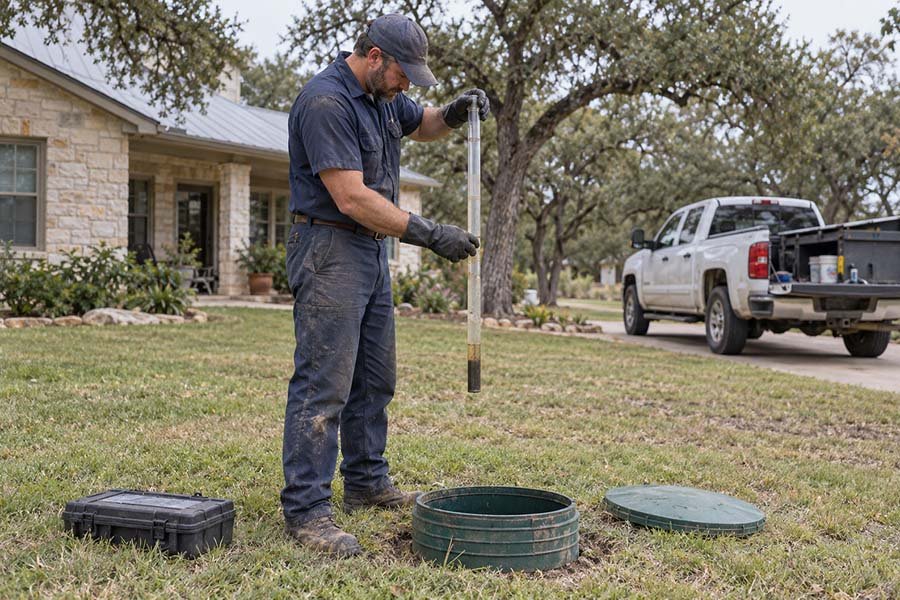
Calendar intervals are useful for planning, but professional inspection of sludge and scum accumulation gives you more information about the actual condition of the tank.
EPA provides three useful pumping indicators.
A tank should be pumped when:
- the bottom of the scum layer is within 6 inches of the bottom of the outlet
- the top of the sludge layer is within 12 inches of the outlet
- sludge and scum account for more than 25% of the liquid depth
EPA also recommends keeping records of sludge and scum levels measured during professional service. Over time, these records can help establish a more property-specific pumping schedule.
This is a better long-term strategy than assuming your tank must always be pumped on the same date every few years.
For example, if professional inspections consistently show slow solids accumulation, those records provide useful information about your system.
If accumulation is faster than expected, the schedule can be adjusted accordingly.
Signs Your Septic System May Need Attention
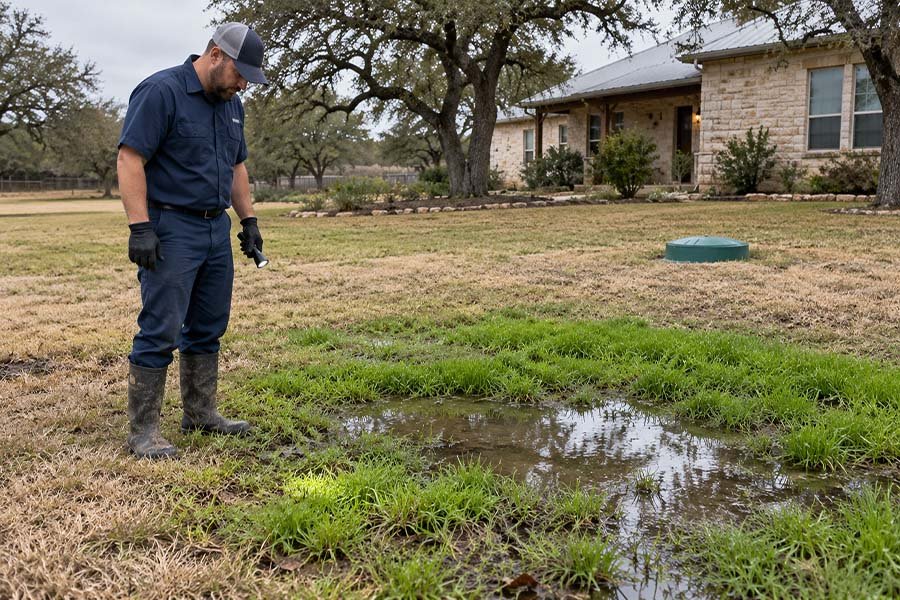
Homeowners often wait for symptoms before thinking about septic pumping.
That is not ideal.
Routine maintenance should happen before the system reaches the point of sewage backup or obvious malfunction.
However, certain symptoms deserve prompt attention.
EPA identifies warning signs of septic-system malfunction that include slow drains, plumbing backups, gurgling sounds, sewage odors, standing water or damp areas around the septic tank or drainfield, and unusually lush or spongy grass over septic components.
These symptoms do not automatically mean the tank simply needs pumping.
A backup could involve the tank, plumbing, drainfield, or another system component. Standing water could indicate a disposal-area problem rather than a tank that only needs to be emptied.
If symptoms are present, the better approach is to determine the cause rather than assuming pumping will solve every septic problem.
What Makes a Septic Tank Need Pumping More Often?
Two homes with similar tanks can still require different maintenance schedules.
Several factors can accelerate solids accumulation or increase the workload placed on the septic system.
More People in the Home
Household size is one of the primary factors identified by EPA.
More people generally means more toilets being flushed, more showers, more laundry, more dishes, and more wastewater entering the septic system.
This is why large households should not automatically follow the same schedule as a one-person or two-person household.
Smaller Septic Tank
Tank capacity matters because smaller tanks provide less volume for wastewater treatment and solids storage.
TCEQ’s household-size table shows shorter estimated pumping or inspection intervals as tank size decreases for the same number of occupants.
High Wastewater Use
EPA identifies total wastewater generated as another major factor affecting pumping frequency.
Leaks and unnecessarily high water use can place additional hydraulic load on the system.
TCEQ recommends conserving water and periodically checking toilets for leaks.
Garbage Disposal Use
Garbage disposals send additional organic solids into the wastewater stream.
EPA includes the amount of solids in wastewater among the factors influencing pumping frequency.
Reducing unnecessary food waste entering the septic system can therefore be part of responsible system use.
What Goes Down the Drain
A septic system should not be treated like a trash-disposal system.
TCEQ specifically advises homeowners not to flush cleaning tissues, cigarette butts, or other trash because doing so adds an undesirable solids load.
Wipes, paper towels, hygiene products, and similar materials should also be kept out of the septic system.
How Often Should a Family of 5 Pump a Septic Tank?
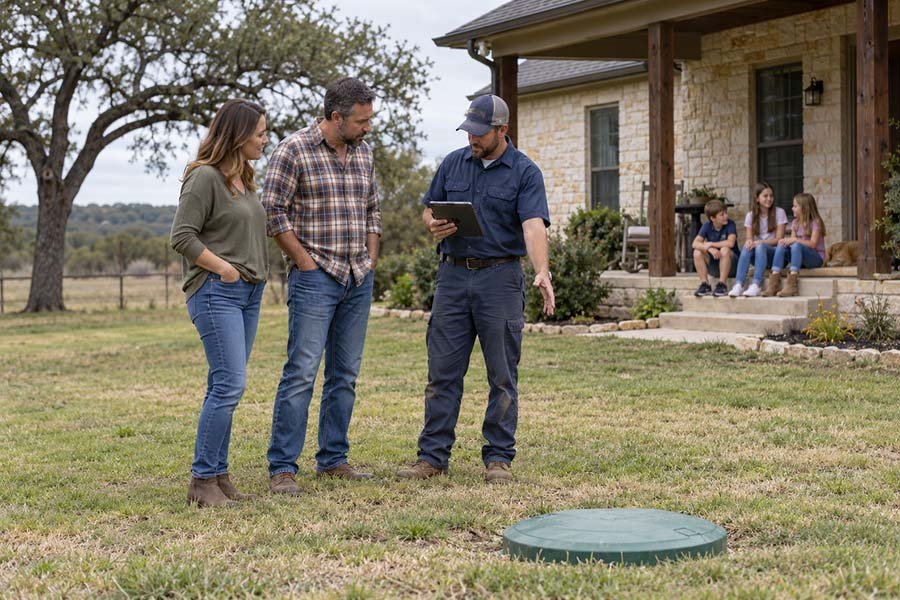
There is no single interval for every family of 5 because tank size makes a substantial difference.
According to TCEQ’s planning table, the estimated duration between pumping or inspections for a five-person household is:
750 gallons
1.3 years
1,000 gallons
2.0 years
1,250 gallons
2.6 years
1,500 gallons
3.3 years
1,750 gallons
3.9 years
2,000 gallons
4.5 years
Again, these are estimates between pumping or inspection, not mandatory pump-out schedules.
A professional assessment of solids accumulation provides better information about whether pumping is actually needed.
This is particularly important for larger households because blindly following a generic 3-to-5-year recommendation could be too long for some tank-size and occupancy combinations.
Do Large Families Need Septic Pumping More Often?
Often, yes.
If everything else remains equal, more occupants generally increase wastewater and solids entering the septic tank.
EPA identifies household size as one of the major variables controlling pumping frequency, while TCEQ’s planning table shows progressively shorter estimated intervals as household occupancy increases.
For example, with a 1,250-gallon tank, TCEQ estimates:
2 people at 7.5 years
4 people at 3.4 years
6 people at 2.0 years
8 people at 1.4 years
Those figures illustrate why large households benefit from paying close attention to maintenance rather than relying on a generic schedule.
How Often Should You Pump a Septic Tank at a Seasonal Home?
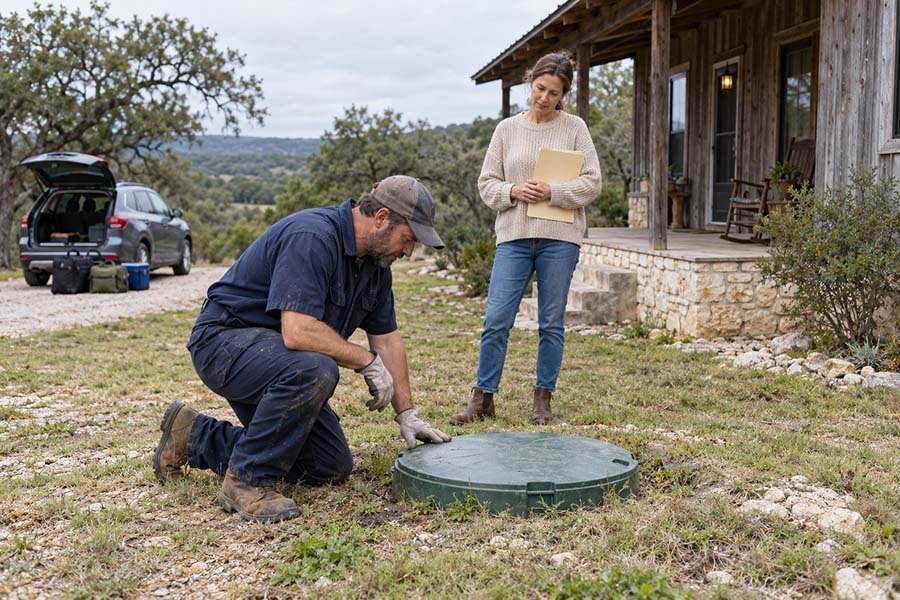
Seasonal homes can accumulate solids more slowly than equivalent properties occupied full time because the septic system may receive less wastewater during the year.
However, seasonal use does not create a universal extended pumping schedule.
The number of occupants, length and intensity of occupancy, tank capacity, guest use, water consumption, and actual solids accumulation still matter.
A property that is empty much of the year but regularly hosts large groups during peak periods may have different maintenance needs from a property occupied occasionally by only one or two people.
Long periods without occupancy also do not eliminate the value of inspecting system condition.
If maintenance history is unknown, establish the condition of the tank rather than assuming seasonal use means pumping can be postponed indefinitely.
Can a Septic Tank Go Longer Than 5 Years Without Pumping?
Some septic tanks can go longer than 5 years between pump-outs.
That does not mean every homeowner should intentionally wait longer than 5 years.
EPA describes 3 to 5 years as a typical household pumping interval, while TCEQ’s planning table includes several household-and-tank combinations with estimates longer than 5 years between pumping or inspections.
The key difference is inspection.
If a tank is inspected and sludge and scum levels remain below the thresholds that indicate pumping is needed, a longer interval may be reasonable for that particular system.
Simply ignoring a tank for 6, 8, or 10 years without knowing what is happening inside it is different.
A longer pumping interval should be supported by actual system condition and maintenance history rather than guesswork.
Can a Septic Tank Go 10 Years Without Pumping?
It is possible for certain low-use systems with sufficient tank capacity to have long intervals between pump-outs.
TCEQ’s planning table even contains several estimated durations longer than 10 years for larger tanks serving very small households.
But that should not be interpreted as a general recommendation to pump every 10 years.
EPA recommends regular inspection and notes that typical household pumping is every 3 to 5 years.
If your septic tank has not been pumped in 10 years, especially if you do not have inspection records showing its sludge and scum levels, having the system evaluated is more sensible than assuming the long interval proves pumping is unnecessary.
What Happens If You Wait Too Long to Pump a Septic Tank?

A septic tank is designed to retain solids.
Over time, sludge settles toward the bottom while scum accumulates near the top. The liquid portion leaves the tank through the outlet and continues toward the disposal area.
As the retained solids accumulate, the available space inside the tank decreases.
If maintenance is neglected, solids can eventually migrate out of the tank and into the drainfield.
EPA identifies lack of routine maintenance as one cause of septic-system malfunction and warns that solids migrating into the drainfield can clog the system.
Pumping before excessive accumulation occurs helps protect downstream components from unnecessary solids loading.
This is also why waiting until sewage backs up into the house is not a good pumping strategy.
Can You Reduce How Often Your Septic Tank Needs Pumping?
Good septic habits can reduce unnecessary stress on the system, but they should not be used as an excuse to avoid pumping when accumulated solids need removal.
Useful practices include conserving water, repairing leaks, avoiding excessive garbage-disposal use, keeping trash and wipes out of toilets, protecting the drainfield, and maintaining accurate service records.
TCEQ also advises homeowners not to add chemical additives or so-called enzymes to an OSSF, noting that some can be harmful to tank operation.
No additive eliminates the basic need to monitor sludge and scum accumulation.
The goal should not be to stretch the pumping interval as long as possible.
The goal is to pump when the tank actually needs it.
How Much Does Septic Tank Pumping Cost?
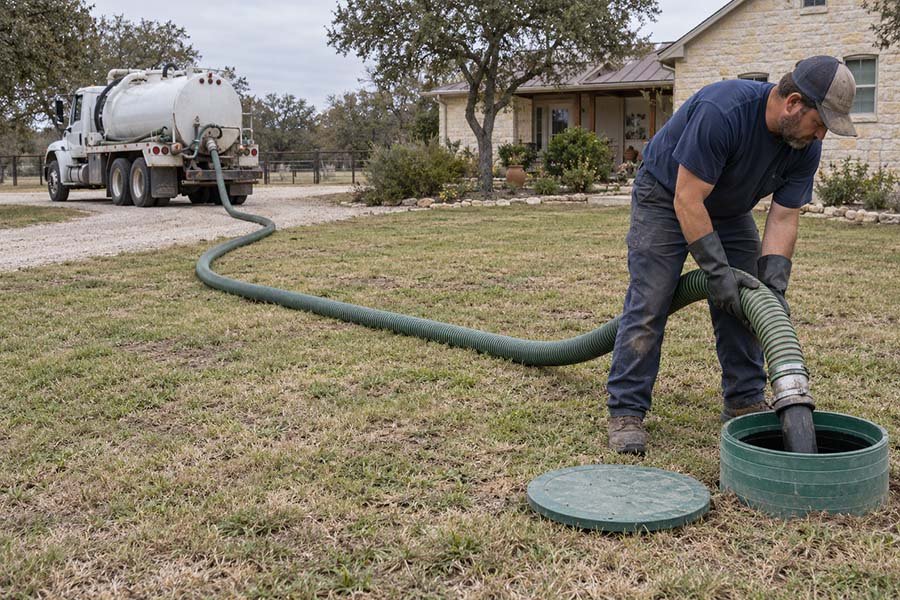
Pumping cost varies according to tank size, accessibility, location, buried access points, accumulated material, and the work required at the property.
Because cost is a separate search intent, we cover it in detail in our guide to how much it costs to pump a septic tank.
Knowing your tank location and maintaining accessible lids or risers can also make future service easier.
If you are unsure where your tank is located, see our guide on how to find a septic tank.
Septic Tank Pumping in Central Texas
Central Texas homeowners should base septic maintenance on the actual system, household use, tank capacity, and service history rather than relying on one universal schedule.
For many households, EPA’s 3-to-5-year guideline provides a useful starting point. Texas homeowners can then use TCEQ’s tank-size and household guidance along with professional inspection results to develop a more appropriate maintenance schedule.
If your tank is due for service or you do not know when it was last pumped, Dillon Septic provides septic pumping services in Texas within our Central Texas service area.
Frequently Asked Questions
How often should a septic tank be pumped?
EPA says household septic tanks are typically pumped every 3 to 5 years. Actual frequency depends on household size, wastewater generation, solids accumulation, and septic tank capacity.
Is septic pumping every 3 to 5 years required?
Not as a universal rule for every household. The 3-to-5-year interval is a general EPA guideline. Some systems may need pumping sooner, while others may go longer when inspections show that solids have not accumulated enough to require pumping.
How often should a 1,000-gallon septic tank be pumped?
It depends heavily on household size. TCEQ estimates 5.9 years between pumping or inspections for 2 people using a 1,000-gallon tank, 2.6 years for 4 people, and 2 years for 5 people. These are planning estimates rather than guaranteed pumping schedules.
Does a large family need to pump more frequently?
Often. Larger households generally generate more wastewater and solids. EPA identifies household size as a major factor in pumping frequency, and TCEQ’s planning estimates shorten considerably as the number of occupants increases.
How often should a seasonal home’s septic tank be pumped?
There is no universal schedule specifically for seasonal homes. Actual use, number of occupants, tank capacity, periods of heavy use, and solids accumulation should determine maintenance. Regular inspection is more reliable than assuming occasional occupancy automatically allows a particular pumping interval.
Final Thoughts
So, how often should you pump a septic tank?
For most households, every 3 to 5 years is a useful general starting point, but it should not be treated as a fixed schedule for every property. EPA identifies household size, wastewater generation, solids volume, and tank size as the major factors influencing pumping frequency.
Texas homeowners have an additional resource in TCEQ’s household-size and tank-capacity table, which demonstrates how dramatically estimated intervals can change based on occupancy and tank size.
The most reliable long-term approach is to combine those guidelines with professional inspection of the tank’s actual sludge and scum accumulation.
Keep records of inspections and pump-outs. Pay attention when household occupancy changes. Use water responsibly and keep unnecessary solids out of the system.
And when the tank reaches the point where accumulated material needs to be removed, schedule professional pumping rather than waiting for a backup or other septic-system problem.